Skip to content
Lotsight
RankingsHow we testAbout
Compare brokers

Risk warning: CFDs and spot forex are complex instruments and come with a high risk of losing money rapidly due to leverage. A large share of retail investor accounts lose money when trading CFDs. Consider whether you understand how they work and whether you can afford to lose your money. Lotsight publishes independent reviews, not personal financial advice.

Lotsight

Forex brokers tested with real deposits, real trades and real withdrawals. Every score comes from an account we funded ourselves.

Categories

  • Beginner-Friendly Brokers
  • Copy & Social Trading
  • Established Multi-Asset Brokers
  • International & High-Leverage Brokers
  • Raw Spread & ECN Brokers
  • US Forex Brokers

Reviews

  • Rankings
  • Search
  • How we test

Company

  • About
  • Contact
  • Privacy
  • Terms
© 2026 Lotsight. Independent broker reviews.No broker pays for a place in our rankings.
Home /Raw Spread & ECN Brokers /Trademax Global review
Raw Spread & ECN Brokers

TMGM Review: Is the Edge Account a Real Rival to the Big Australian ECN Brokers?

TMGM prices its Edge account at 0.0 pips plus a $7 commission and holds an ASIC licence alongside three offshore ones. We checked whether that combination genuinely competes with IC Markets and Pepperstone, or trades on the ASIC name while routing most clients through Vanuatu.

7.3/10 overall score

Best for: Cost-focused ECN traders who confirm their entity first and accept VFSC oversight if it is not ASIC

TMGM's Edge account genuinely competes on price: 0.0 pips plus a $7 round-turn commission on FX and $5 on metals sits right beside what IC Markets and Pepperstone charge on their raw tiers, and $100 opens it. The catch is which entity actually signs the contract, since ASIC caps retail leverage at 1:30 while the 1:1000 figure in TMGM's marketing belongs to the Vanuatu entity that onboards most clients outside Australia. An Australian resident opening under ASIC gets a fairly priced, protected account. A trader signing up elsewhere is choosing Vanuatu's lighter oversight for that higher leverage, and should weigh the trade honestly.

Price $100 minimum depositMaker Trademax Globaltmgm.com

By The Lotsight Test Desk · 6 February 2026

tmgm.comTMGM homepage hero reading Join 1 Million Investors over a full-width background videoVisit site
Score
7.3 / 10
Price
$100 minimum deposit
Maker
Trademax Global
Category
Raw Spread & ECN Brokers
Published
06 Feb 2026
Tested by
The Lotsight Test Desk

TMGM markets itself with an ASIC licence front and center, a strong claim in a field where most competitors settle for an offshore registration. The Edge account is the product that has to justify that positioning: raw-style pricing at $100 to open, going head to head with brokers that have built their entire brand on being the cheapest ECN option in Australia. We priced Edge against that field and then traced which regulator actually signs up a trader who lives outside Australia.

Edge prices like it belongs in the conversation

Edge quotes spreads from 0.0 pips and charges $7 per round-turn lot on forex, dropping to $5 on precious metals. Run the math on a standard EUR/USD lot and that lands close to 0.7 pips all-in, competitive with IC Markets' Raw Spread account and Pepperstone's Razor tier, the two names TMGM gets compared against most often. The $100 minimum deposit is unremarkable on its own, but paired with that pricing it makes Edge accessible to a trader who is not ready to fund a four-figure account just to access raw spreads.

TMGM Trading Conditions page headline reading Superior Trading Conditions, describing ultra-tight spreads, low swap rates and exceptional execution speed
TMGM's Trading Conditions page, framing its spreads and execution around the Edge account's pricing.

Classic sits beside Edge as the no-commission alternative, quoting from 1.0 pip with nothing added on top. It exists for traders who dislike seeing a commission line item, but the math rarely favors it: a EUR/USD trade on Classic costs more once you compare the all-in spread against Edge's combined spread and fee.

Two account types, one MetaTrader stack

Both Edge and Classic run on MT4 and MT5 with the full range TMGM advertises: expert advisor support, an Islamic swap-free option, and a 20 percent stop-out level that gives a leveraged position more room before forced liquidation than some competitors' tighter stop-out thresholds.
More in Raw Spread & ECN Brokers

  1. 01IC Markets Global18 Sept 20268.4
  2. 02Fusion Markets06 Aug 20268.2
  3. 03Tickmill Group05 Apr 20268.2
  4. 04Pepperstone Group06 Sept 20268.1
  5. 05First Prudential Markets17 Apr 20268.0

Highest scores overall

  1. 01IC Markets GlobalRaw Spread & ECN Brokers8.4
  2. 02Fusion MarketsRaw Spread & ECN Brokers8.2
  3. 03Tickmill GroupRaw Spread & ECN Brokers8.2
  4. 04Pepperstone GroupRaw Spread & ECN Brokers8.1
  5. 05StoneX GroupUS Forex Brokers8.1
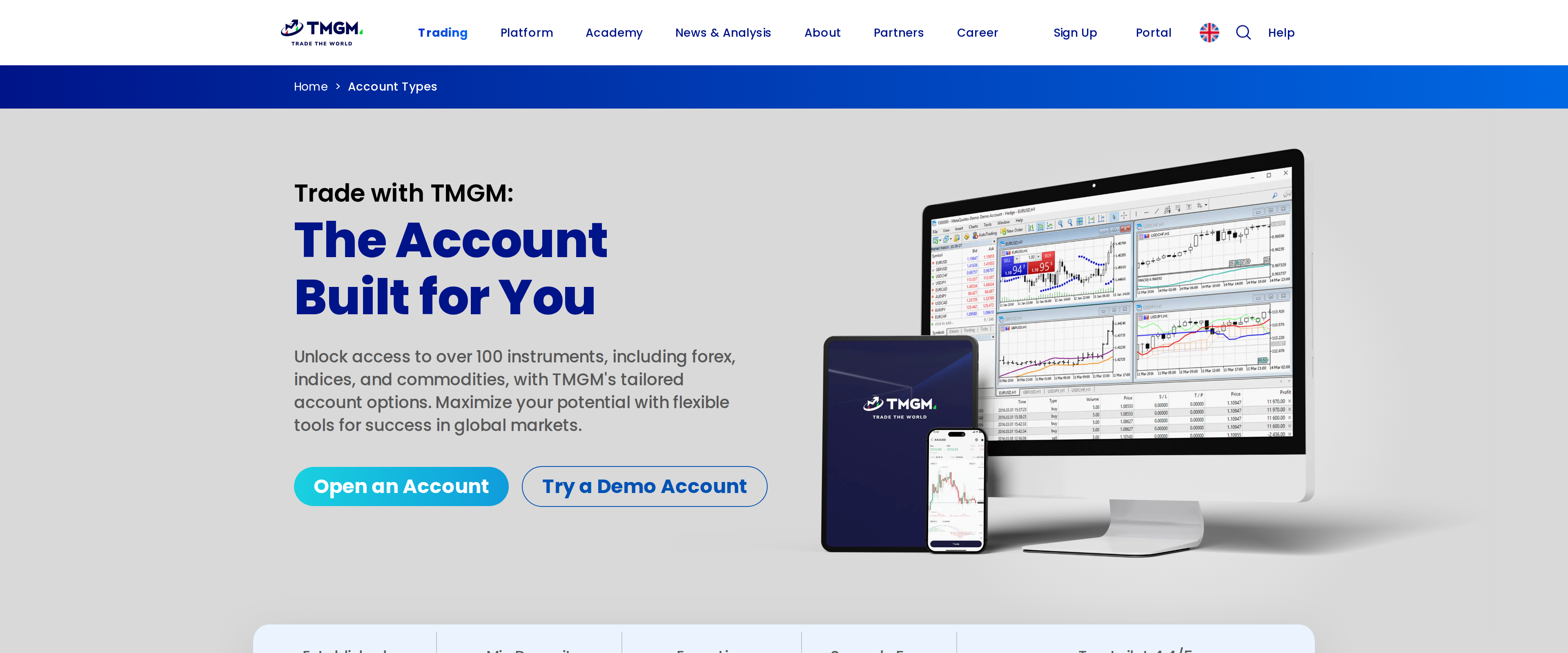
TMGM Account Types page headline reading The Account Built for You
The Account Types page, where TMGM lays out Edge against Classic side by side.

The catalogue behind those accounts is genuinely broad: TMGM lists more than 12,000 tradable instruments spanning forex, indices, shares, commodities and crypto CFDs, a wider spread of markets than most brokers offer on a single MT4/MT5 login without a separate multi-asset platform.

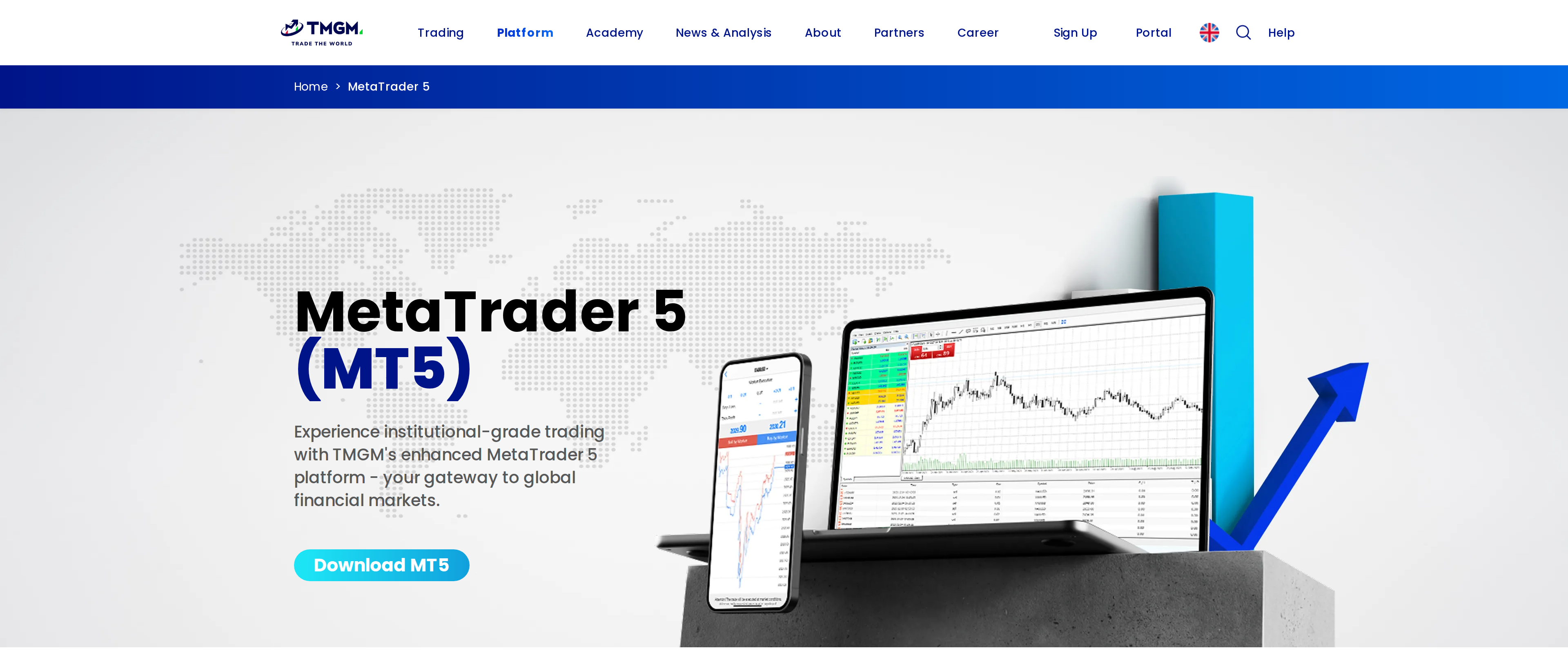
TMGM MetaTrader 5 platform page headline reading MetaTrader 5 (MT5), describing institutional-grade trading and a gateway to global financial markets
The MT5 platform page, one of two MetaTrader builds available on every TMGM account.

The ASIC name and the Vanuatu reality

Here is the detail that matters more than any spread figure: TMGM trades under four separate legal entities, and ASIC's Australian licence (AFSL 436416) is only one of them. Australian securities law caps retail leverage at 1:30, full stop, so any TMGM marketing that advertises leverage up to 1:1000 is describing the Vanuatu entity, regulated by the VFSC under registration 40356, not the ASIC one. Most clients signing up from outside Australia are onboarded through Vanuatu, Seychelles or Mauritius rather than through ASIC, and those regulators carry lighter capital requirements and fewer formal channels if a dispute needs resolving.

None of that makes TMGM dishonest. The license numbers are published, and an Australian resident really can open an ASIC-regulated account with the protections that implies. What it means is that a trader anywhere else is choosing VFSC oversight in exchange for higher leverage, a trade that is easy to make without realizing it if you only read the ASIC badge on the homepage and skip the entity disclosure in the account-opening paperwork.

Segregated funds and where support actually sits

TMGM keeps client money in segregated bank accounts separate from its own operating funds, a baseline protection that applies across all four entities regardless of which one signs a particular client. Support runs 24 hours across the trading week through live chat, phone and email, and the account verification process follows the standard document-upload pattern most brokers now use: proof of identity, proof of address, and a short waiting period before funds can move.

A decade in business, 2013 to now, is a middling track record: long enough to have weathered a market crisis or two, short enough that TMGM still sits behind the fifteen-plus-year incumbents on pure longevity. That maturity shows up in the polish of the account-opening flow and the platform stability more than in any single number on a spec sheet, and it is worth factoring in separately from the leverage and entity questions above.

Verdict

TMGM earns its comparison to the established Australian ECN brokers on price alone: Edge's 0.0-pip spread and $7 commission is a real number, not a marketing floor that only applies to a handful of pairs. The ASIC licence adds a layer of credibility that plenty of offshore-only brokers cannot claim. Where a trader needs to slow down is the entity question: check which regulator is actually signing your account agreement before assuming ASIC-level protection applies, because for most non-Australian traders it will not. This is not personalised trading advice, and CFDs are leveraged products that can produce losses larger than the amount deposited.

What we liked

  • Edge account prices from 0.0 pips plus a flat $7 FX commission ($5 on metals) per round-turn lot, matching the established Australian ECN field
  • ASIC licence (AFSL 436416) is available for Australian residents, with segregated funds and negative balance protection under that entity
  • 12,000+ tradable instruments across forex, indices, shares, commodities and crypto CFDs, a wide catalogue for a single account
  • $100 minimum deposit opens either the Edge or Classic account, with MT4 and MT5 both included at no extra cost

What held it back

  • 1:1000 leverage only applies under the Vanuatu VFSC entity; ASIC caps retail leverage at 1:30 by Australian law
  • Most clients outside Australia are onboarded by the Vanuatu, Seychelles or Mauritius entity rather than the ASIC one, despite ASIC being the headline regulator in TMGM's marketing
  • The Classic account's 1.0-pip spread with no commission is not competitive once the Edge account exists on the same platform
  • Offshore entities carry lighter capital and disclosure requirements and fewer formal recourses in a dispute than ASIC provides

Key facts

Founded
2013, Sydney, Australia
Regulators
ASIC (AFSL 436416), VFSC Vanuatu (40356), FSA Seychelles (SD224), FSC Mauritius
Edge account spread
From 0.0 pips plus $7 FX / $5 metals commission per round-turn lot
Classic account spread
From 1.0 pips, no commission
Minimum deposit
$100 (Edge or Classic)
Leverage
Up to 1:30 (ASIC retail), up to 1:1000 (VFSC entity)
Tradable instruments
12,000+ across forex, indices, shares, commodities, crypto CFDs
Platforms
MT4, MT5, mobile apps
Stop-out level
20%
Account extras
Islamic swap-free option, EA and algorithmic trading permitted
Visit site

Tested by The Lotsight Test Desk with a funded live account. Scores reflect what we saw during testing and are not personal financial advice. CFDs are complex instruments and carry a high risk of losing money rapidly due to leverage.